Increase ROAS With Better Creative Under Fatigue
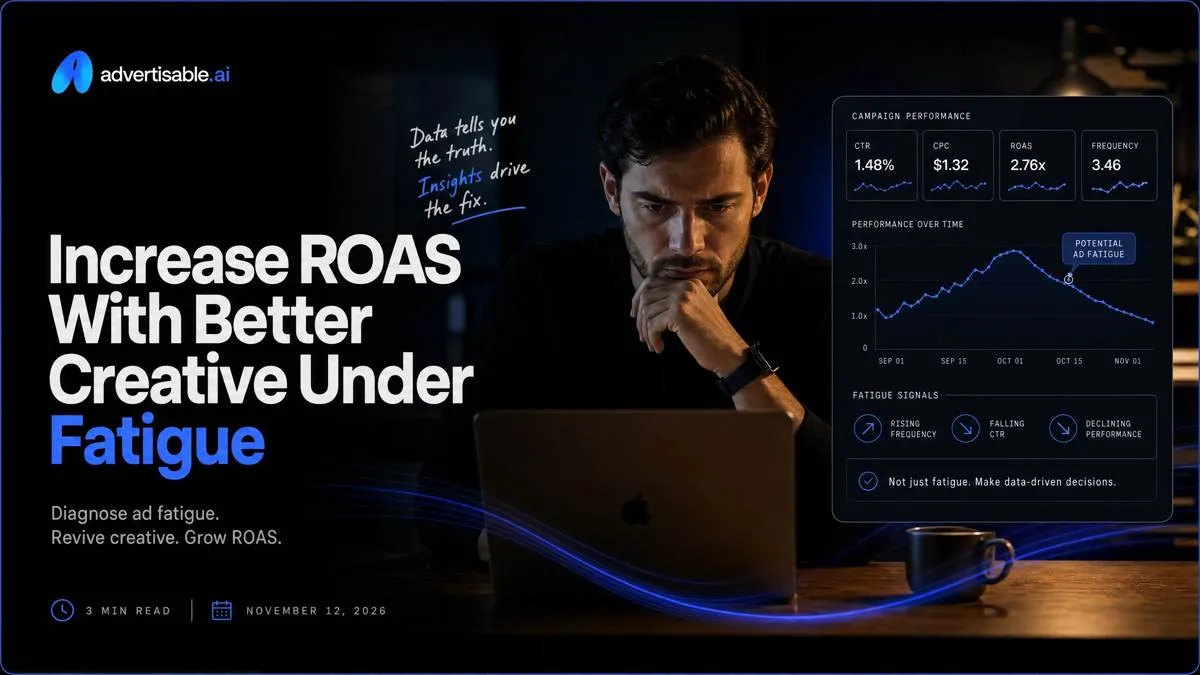
The creative changes that most reliably increase ROAS on paid social are controlled, single-variable edits to the bottleneck scene, usually the hook, run in batches with a fixed 48 to 72 hour readout. If you swap the hook, offer, proof, and CTA at once, you do not learn what moved performance.
We built Advertisable AI for the exact constraint this workflow hits in the real world: you need to ship volume without losing control. Our URL-to-storyboard workflow extracts Brand DNA from your product page, then lets you regenerate or swap individual scenes at the frame level so you can fix only what is failing and export in platform-ready formats for Meta, TikTok, and YouTube.
Next we’ll start where ROAS usually moves first under fatigue: which creative changes actually lift performance fastest when the audience has already seen the concept.
What creative changes increase ROAS fastest when fatigue hits?
You do not fix fatigue by “making new ads.” You fix it by isolating the one scene that stopped doing its job, then shipping controlled edits in 48 to 72 hour readouts. The fastest ROAS lifts usually come from changing one beat (hook, offer and CTA, or proof) while holding the rest constant so the platform feedback is attributable.
Hook packs, not new concepts
The fastest creative refresh is a hook pack: 10 hook variants for one proven angle, tested as a batch over 48 to 72 hours. Most “fatigue” is your first 2 seconds losing thumb stop, not the entire concept failing.
Hold the body of the ad constant (product moment, proof, CTA, length, captions, claims) and rework only the opening. You are buying a clean signal: which opening pattern restores attention without introducing new confounds.
- Acceptance criteria: all 10 variants share the same scenes after second 2, same on-screen product, same offer language, same CTA screen
- First-2-seconds options to rotate: problem statement, result-first, objection callout, pattern interrupt visual, “what this is” label, founder line, fast demo start
- Next-test decision: regenerate only the losing hook styles, keep the winning hook family and move to the next bottleneck beat
Offer and CTA swaps first
When clicks are there but purchases soften, offer framing and CTA wording are the quickest swaps that can restore intent without rebuilding the ad. Run one variable per batch so you can attribute movement inside a 48 to 72 hour window.
Start with framing before discounting. You are testing why to buy now, not racing to the lowest price.
Then tighten the CTA verb and the next step so the viewer knows exactly what happens after the click.
- Offer framing tests (no new discount required): “ships today” vs “free returns”, bundle clarity, guarantee clarity, “made for X use case” positioning
- CTA verb tests: Get, See, Build, Compare, Start, Claim, Watch
- Next-step clarity: “Take the quiz”, “Choose your size”, “See it in action”, “Pick your bundle”
Proof inserts that earn trust
When your hook and offer are stable but conversion rate drifts, you usually need better proof, not louder copy. The fast move is inserting trust elements into the same structure, not inventing a new storyline.
Use proof that is readable in-feed: short UGC quotes, star rating overlays, or a single specific outcome line. If you use before-after, add a plain disclaimer on-screen so you stay compliant and credible.
Prefer a quick demo over description. Showing the product doing the job typically carries more weight than another paragraph of benefits.
- Proof inserts: 6 to 10 word UGC quote overlays, “4.7 stars” style rating overlay, “X reviews” count if you have it
- Before-after: same lighting and angle, short hold time, on-screen disclaimer (results vary, typical use, no implied guarantees)
- Demo options: unboxing to first use, side-by-side comparison of outcome, one feature shown end-to-end in under 5 seconds
How do you diagnose whether hook, offer, proof, or CTA is failing?
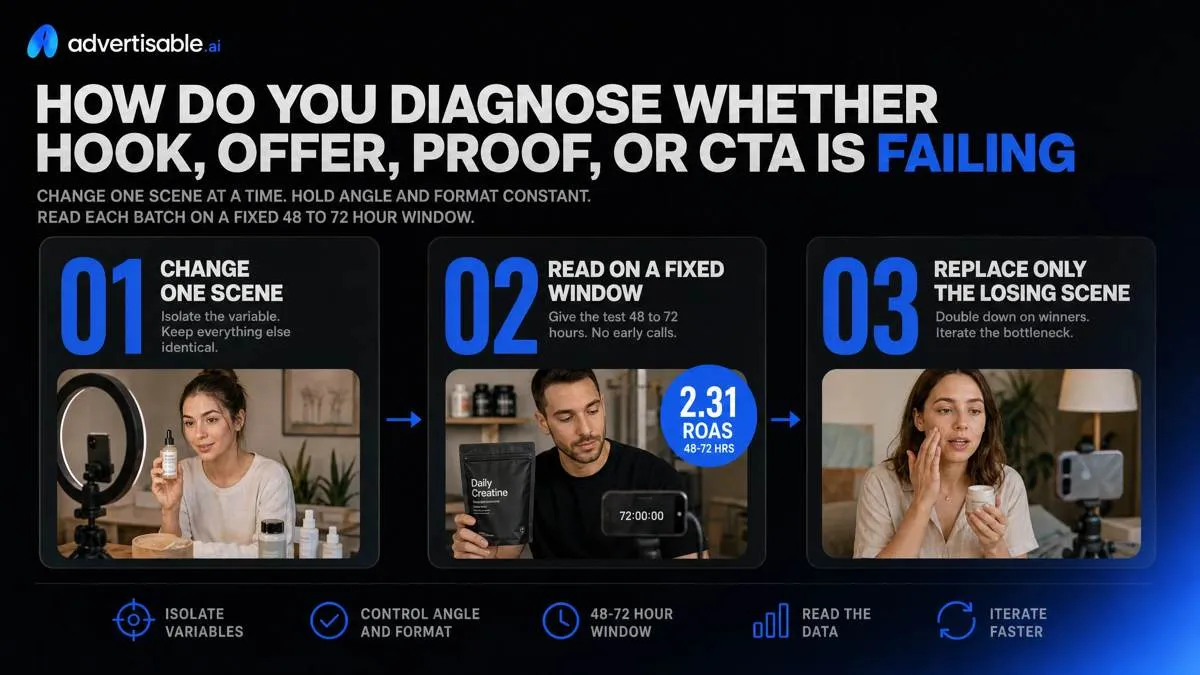
The diagnosis rule is simple: change one scene at a time, not the whole ad. Hold the angle and format constant so you can attribute movement to a single bottleneck. Read each batch on a fixed 48 to 72 hour window, then replace only the losing scene.
Hook failure signals
Hook failure is when you cannot earn attention cheaply enough to give the rest of the ad a chance. You will see it inside 48 to 72 hours because top of funnel signals break first.
The tell is low thumbstop and weak holds: impressions come in, but the view curve collapses immediately. That usually means the first 1 to 2 seconds are not pattern-breaking, or the opening visual does not match the promise of the angle.
High CPM paired with low engagement is another hook-level warning. Platforms price inventory based on expected response; when the feed predicts low interaction, you pay more for fewer meaningful actions.
Comments are your qualitative read: if people misread what the product is or who it is for, your opening framing is unclear even if the edit looks “clean.”
- Next test decision: ship a 10-20 variant hook pack where only the first scene changes.
- QA check: the first line and first visual must name the category and the outcome in plain language.
- Acceptance criteria: thumbstop and early retention lift without needing offer or proof edits.
Offer failure signals
Offer failure is when people watch, but they do not click or they click without purchase intent. You have attention, but the value exchange is not landing.
You will typically see good hold with low CTR. That points to the product moment and terms: the viewer understands the story, but not what they get, why now, or why this is the right deal.
If you do get clicks but add-to-cart stays low, the offer is either unclear, misaligned to the landing experience, or anchored to the wrong reference price. Price anchoring mismatch shows up when the ad implies one price tier and the page reveals another, or the bundle and shipping math surprises them.
- Next test decision: keep the same hook and proof, swap only the offer scene (price, bundle, bonus, guarantee language).
- QA check: the ad and landing page show the same “from” price, bundle contents, and shipping expectations.
- Acceptance criteria: CTR improves first; add-to-cart follows without changing traffic quality.
Proof and CTA signals
Proof and CTA are failing when CTR is fine but CVR drops, meaning you are generating clicks without enough trust or clarity to complete the next step. This is where budget gets burned because the ad looks “healthy” in-platform.
High CPC with weak onsite intent is the paired symptom: you pay for the click, then sessions bounce fast or scroll depth is shallow. That usually means your proof did not answer the obvious objections, or your CTA did not set an explicit expectation for what happens after the tap.
CTA failure is not just wording. It is friction in the next step: an unclear action, too many choices, or a landing view that does not match what the ad promised.
- Next test decision: keep hook and offer constant, insert one proof element (demo, claim substantiation, testimonial snippet) or rewrite only the CTA scene.
- QA check: the CTA states one action and one outcome (what you do, what you get), and the landing above-the-fold matches the ad’s promise.
- Acceptance criteria: CVR lifts while CTR stays within the same range, indicating higher-intent clicks rather than different clicks.
The 7-day cadence that raises ROAS without endless spend
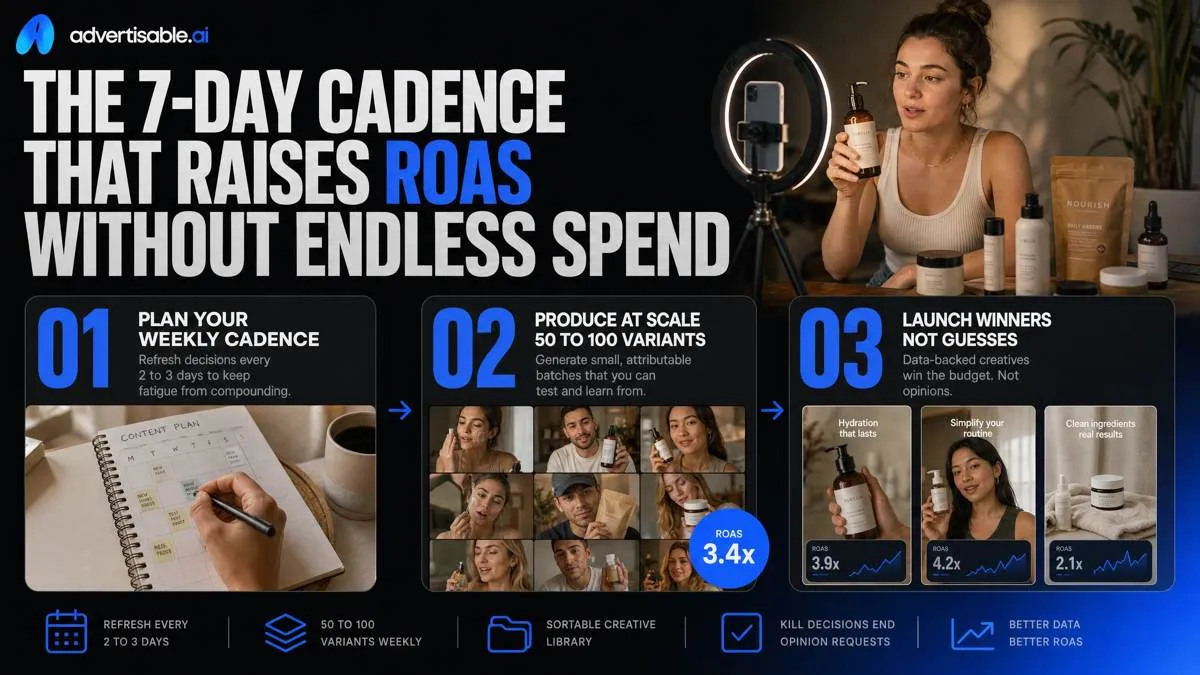
Your cadence is the budget-control mechanism: refresh decisions every 2 to 3 days, not whenever performance panics hit. To keep fatigue from outpacing production, plan for 50 to 100 variants per week, generated as small, attributable batches.
Keep your creative library sortable with a naming convention you can scan in Ads Manager: DATE_CHANNEL_CONCEPT_BOTTLENECK_CELL_VARIANT (example: 2026-11-12_META_A1_HOOK_C2_V03). When you do this, kill decisions and re-gen requests stop being opinion-driven.
Single-variable testing batches
Ship 3 to 5 variants per testing cell, and change exactly one variable. That keeps spend bounded and makes any lift attributable.
Pick one bottleneck per cycle (hook, product moment, proof, or CTA) and only regenerate that scene. Leave every other beat locked so you are not paying to re-test what you already know.
Keep stable controls live the entire week: 1 to 2 “known good” ads that do not change. Controls are your QA gate against platform drift and seasonality, and they prevent you from mistaking market movement for creative improvement.
- Batch acceptance criteria before launch: same offer, same CTA, same landing page, same format exports
- Cell examples: Hook-only cell (5 hooks), Proof-only cell (3 proofs), CTA-only cell (3 CTAs)
48-72 hour readouts
Use a fixed 48 to 72 hour readout so you get signal before fatigue and auction volatility rewrite your results. The metric you read depends on where the bottleneck sits in the funnel.
Set a minimum spend per variant before you rank anything. In practice, we require a preset floor you can afford across 3 to 5 variants, or you will overreact to noise.
Run a fatigue check on every readout: frequency up and CPA up is a different problem than frequency flat and CPA up. You need both numbers to decide whether to refresh the same concept or move on.
- Early signal metrics by stage: thumb-stop/hold rate for hook, CTR for click intent, CVR for onsite alignment, CPA for unit economics
- Readout QA: exclude clear delivery outliers (0 impressions, broken tracking) before making keep-kill calls
Stop rules for bad concepts
Kill concepts fast so budget goes to the few ideas that can actually carry ROAS. Our default stop rule is two cycles with no directional lift versus control, even after you fix the obvious losing scene.
Stop immediately when you see negative feedback stacking with rising CPM. That combination usually means the market is penalizing the message, not just ignoring it.
Do not keep polishing creatives when the onsite mismatch persists. If the ad promise and the landing experience keep disagreeing, another hook variant will not save the concept.
- Stop after 2 cycles when: CTR and CPA do not move in the right direction relative to control
- Stop when: negative comments or hides rise while CPM rises in the same window
- Stop when: you repeatedly see strong clicks but weak conversion because the page does not match the ad claim or angle
Where teams lose ROAS in production, not strategy
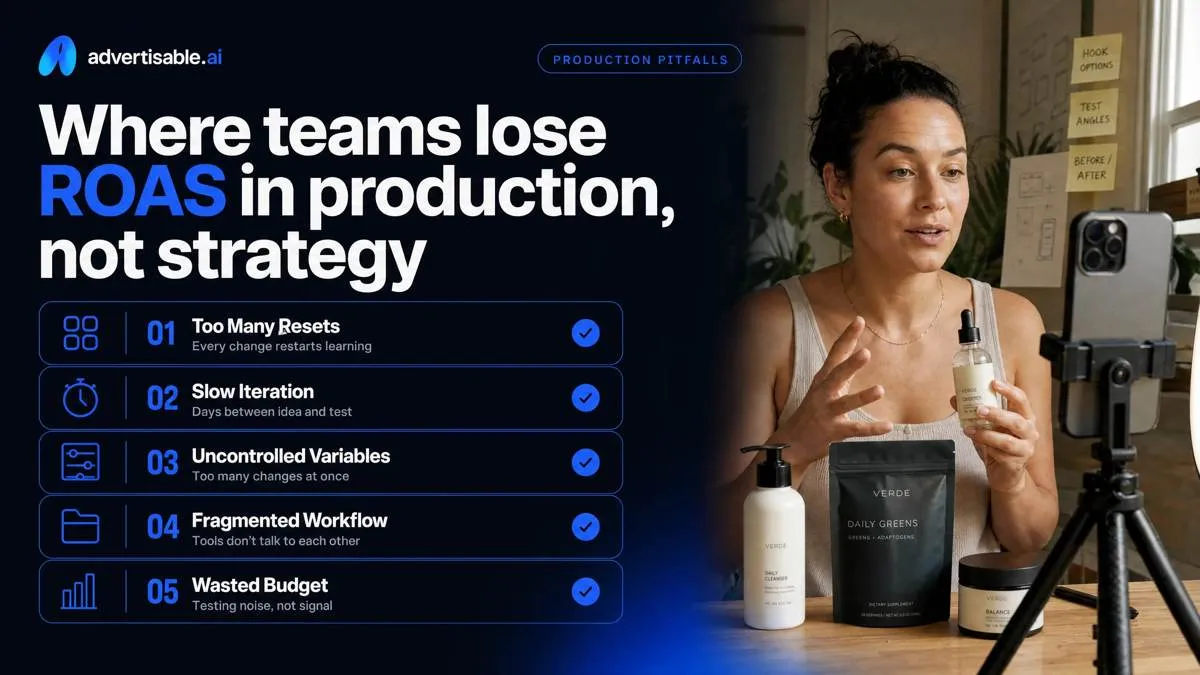
{ "h2_heading": "Where teams lose ROAS in production, not strategy", "intro_paragraphs": [ "Your strategy is usually fine. Your ROAS stalls because you cannot ship enough controlled variations fast enough, so you fall back to “new ads” that change everything at once and reset learning.\n\nFull re-renders are the first drag. If every hook change forces a new edit, new captions, new music, and new exports, your 48 to 72 hour iteration loop turns into a week, and fatigue gets there first.\n\nThen brand drift creeps in across variants: different claims, different tones, different visual rules.
Now your test is polluted, and the winner is not attributable.\n\nExport mismatches across placements create avoidable performance loss. platform specification guides call out how aspect ratio errors produce black bars and tiny-looking videos, especially when you force horizontal into vertical.\n\nFinally, QA gaps create false negatives: broken captions, muted audio, clipped safe zones, wrong landing URLs. Bad execution makes good concepts look like losers.", "subsections": [] }
How do you ship 50-100 on-brand variations weekly?
Hitting 50 to 100 variations a week is rarely a “more effort” problem. It is a tooling problem: generic video editors force full re-renders, and every change invites drift. A storyboard with scene-level control lets you change one beat while keeping the rest identical, so your tests stay attributable.
Set acceptance criteria before you generate anything: every on-screen claim must match the product page wording, required disclaimers (if any) must be present, and visual assets must be approved. Then make handoff clean with a naming convention that survives Slack and Drive: Concept-01_Hook-A_Proof-1_CTA-1_v03, plus a changelog note for what scene changed.
URL to storyboard workflow
To ship at this pace, your product link has to be the source of truth. You feed one hero product URL in, and you get scripts and shot lists as a storyboard, not a blank timeline you have to build by hand.
In Advertisable AI, the URL-to-storyboard flow is designed for operators running batches: generate three distinct concepts in minutes, then pick the one that fits the week’s test plan. Because the output is already structured into scenes, you can align it to your four-beat anatomy (Hook, Product Moment, Proof, CTA) without rewriting from scratch.
- Input: one product link (plus a short prompt to define the angle)
- Output: storyboarded scripts with suggested shots per scene
- Speed target: 3 initial concepts in minutes, then turn the winner into a 10 to 20 variant batch by swapping only one scene
Brand DNA guardrails
Speed fails when accuracy fails. Brand DNA guardrails solve that by pulling usable claims and assets from the source page, then using them as constraints while you generate variations.
Practically, you lock tone and styling once, then iterate inside the box. That reduces compliance risk because you are not freelancing new promises every time you regenerate a hook.
Your QA is simple: every claim in the script must be traceable to the page or your approved claim bank, and every asset must be from your approved library.
- Claims: match page language (no new superlatives, no implied outcomes you cannot support)
- Assets: product images, logos, colors, and approved creative elements stay consistent
- Tone: keep voice and formatting stable so “new variation” does not become “new brand”
Scene-level regeneration control
Weekly volume comes from fixing only what is losing. Scene-level regeneration means you swap the hook scene only, keep the proof scene constant, and ship another 10 to 20 variants inside the same 48 to 72 hour readout cycle.
This is also where generic editors slow you down: they make you duplicate timelines, re-edit, and re-export every time. With scene-level control, the storyboard stays intact and you replace a single beat.
Once the scenes are stable, export in platform-ready sizes so your team is not manually resizing for distribution.
- Regenerate Hook: replace scene 1 while holding Product Moment, Proof, and CTA unchanged
- Lock Proof: keep the exact same proof visual and wording across the batch to protect attribution
- Exports: render Meta and TikTok aspect ratios without rebuilding the edit
Turn creative fatigue into a controlled refresh cadence
If your ROAS is stalled, you do not need more random concepts. You need a clean signal. Lock your four-beat structure, pick one dependent metric for the batch, then change one scene at a time in a fixed 48 to 72 hour readout.
We built Advertisable AI for this exact workflow. You start from one hero product URL, and our platform extracts Brand DNA to keep claims, visuals, and tone consistent across variants. From there, you generate storyboard concepts, then iterate at the scene level so you are fixing the bottleneck beat, usually the hook, without redoing the whole ad.
Start a $5 trial on one hero product page. Generate three storyboard concepts from the URL, export Meta and TikTok formats, then run a 10 to 20 variant hook pack and regenerate only the losing scene in your next cycle.