AI video ads 2026: cost model for scaled teams

In 2026, what will matter most for AI video ads is your operating model, not your generator: total cost of ownership, proof your leadership will accept, and compliance you can audit.
We built Advertisable AI because scaled teams kept hitting the same bottleneck: you need more video variations, but you also need control. Our workflow starts from a product link, extracts Brand DNA as guardrails, then generates scripts and storyboards you can edit and regenerate at the scene or frame level so testing stays controlled.
The fastest way to tighten your 2026 cost model is to start where the money is actually moving, because channel mix dictates iteration volume, review load, and what “efficient” even means. Let’s map where 2026 video budgets are shifting and how that changes your baseline assumptions before you price tooling, people, and compliance.
Where 2026 video budgets are shifting and what that means for your cost assumptions
Your cost model breaks when you assume “one video” is the unit of work. In 2026, the unit is the controlled variant set per channel, with different iteration speeds and quality bars.
Social outpaces CTV in iteration
Social is where you will feel AI scale pressure first because the learning loop is measured in 48 to 72 hours, not weeks. The cost driver is not the first cut, it is the volume of variants you can ship without losing control.
Budget for fatigue. You are refreshing hooks and first scenes on a cadence that can be daily in high-spend accounts, while holding brand guardrails constant so you can attribute lift to one change.
- Marginal cost is dominated by variant count: each additional hook, opener, or angle adds QA and trafficking work even if generation is cheap
- 72-hour readouts push storyboard-first workflows and single-variable batches so you do not “learn” from messy mixes
- Fatigue management becomes an operating requirement: rotate concepts, not just edits, before CPM and hold time degrade
CTV demands higher QA standards
CTV is slower to iterate, but less forgiving when you ship something off-spec. You should assume higher QA labor per asset and longer calendar time per approval, even if creative production is automated.
The failure modes are predictable: spec compliance, loudness, and brand risk. A single violation can get the spot rejected or pull spend, so “good enough for social” does not clear the bar.
- Spec compliance: correct aspect, safe zones, captions, and file packaging, plus loudness consistency across versions
- Brand risk intolerance: stricter claim scrutiny, talent likeness sensitivity, and fewer acceptable “near misses”
- Longer approval cycles: more stakeholders, more rounds, and fewer chances to swap assets mid-flight
KPIs moved closer to outcomes
Video success is being judged closer to revenue, not views. You are increasingly optimizing for sales and store visits, then proving lift with incrementality, not just platform-reported attribution.
That shifts your cost assumptions: creative is a performance lever, so you fund iteration where it can move conversion rate or visit rate, and you measure it with clean tests.
- Outcome priority: sales and store visits outrank reach-only reporting in budget conversations
- Incrementality expectations: holdouts or geo splits are becoming table stakes for CTV and increasingly common elsewhere
- Creative as lever: Forrester's CTV creative study reports 95% agree variety and speed of creative variations impact performance more than audience targeting alone
How much do AI video ads cost in 2026 when you include the full system?
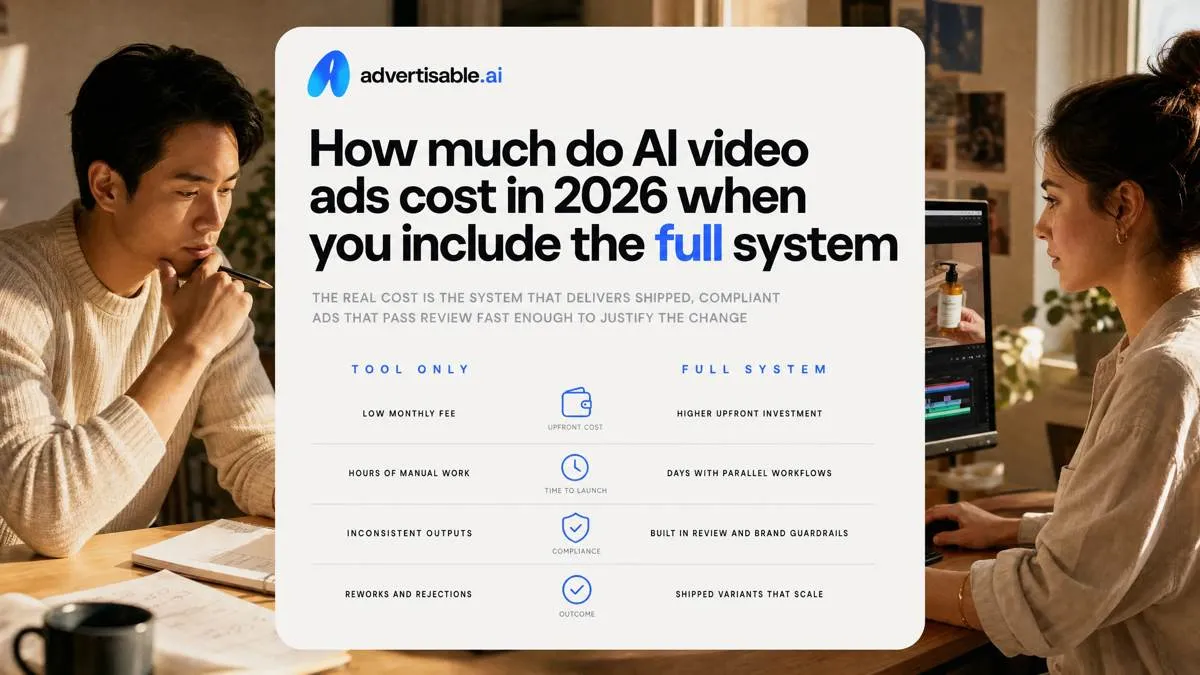
The mistake that gets GenAI budgets rejected is pricing “the tool” instead of the system. Leadership is not buying renders. They are buying shipped, compliant ad variants that pass review fast enough to justify the operating change.
The TCO equation you can audit
Model cost per shipped variant, not cost per generated draft. Your unit economics should start at “export-ready file that can run on Meta, TikTok, or YouTube today,” because that is what finance can reconcile to performance.
Use pass rate and rework rate as first-class multipliers. If 60% of drafts pass on first review, your effective cost per shipped variant is 1 divided by 0.60 times your per-draft cost, before you even count rework minutes.
In the worksheet, convert everything to fully loaded labor minutes (creator, editor, PM, QA, legal) and assign an internal cost per minute. That is how you avoid the common trap where AI looks cheap because people “don’t count” their time.
- Inputs you need: shipped variants per week, drafts generated per week, first-pass approvals, average rework loops per shipped variant
- Minutes per step: brief intake, prompt+storyboard, scene fixes, audio/caption polish, export+upload, review coordination
- Fully loaded rates: blended $/hour per role (or one blended $/minute for the whole lane)
Cost buckets teams forget to price
The hidden costs are mostly human and mostly predictable. Price them up front, or you will overspend on tools while underfunding the work that makes outputs shippable.
Prompting and storyboarding time is not “creative play.” It is your spec writing, and it scales with the number of distinct concepts you test. QA and spec fixes are the tax you pay for getting aspect ratios, safe zones, captions, and product facts correct. Legal and platform reviews are the gating function that determines whether leadership will allow scale.
- Prompting and storyboarding: time to translate an offer into scenes, claims, and on-screen text you can defend
- QA and spec fixes: caption accuracy, logo placement, resolution, audio levels, cut timing, export variants per placement
- Legal and platform reviews: claim substantiation checks, rights clearances, disclosure requirements, policy re-submissions
Break-even versus traditional production
Break-even is a volume question: how many shipped variants per month makes your AI system cheaper than agency or freelancer production. Your baseline should be your real last-90-days cost per delivered edit, including producer time and revision rounds, not the sticker price on a statement of work.
The payback threshold usually shows up when you need continuous testing output, not when you need one hero spot. The sensitivity you cannot ignore is pass rate: a swing from 80% to 50% first-pass approval can erase the savings because rework consumes the same senior minutes leadership is already short on.
- Baseline comparator: cost per delivered cut (not per shoot day), and average revision cycles per cut
- Volume threshold: planned shipped variants per week across platforms and placements
- Sensitivity check: run the model at 80%, 60%, and 40% pass rates and watch where your unit cost flips
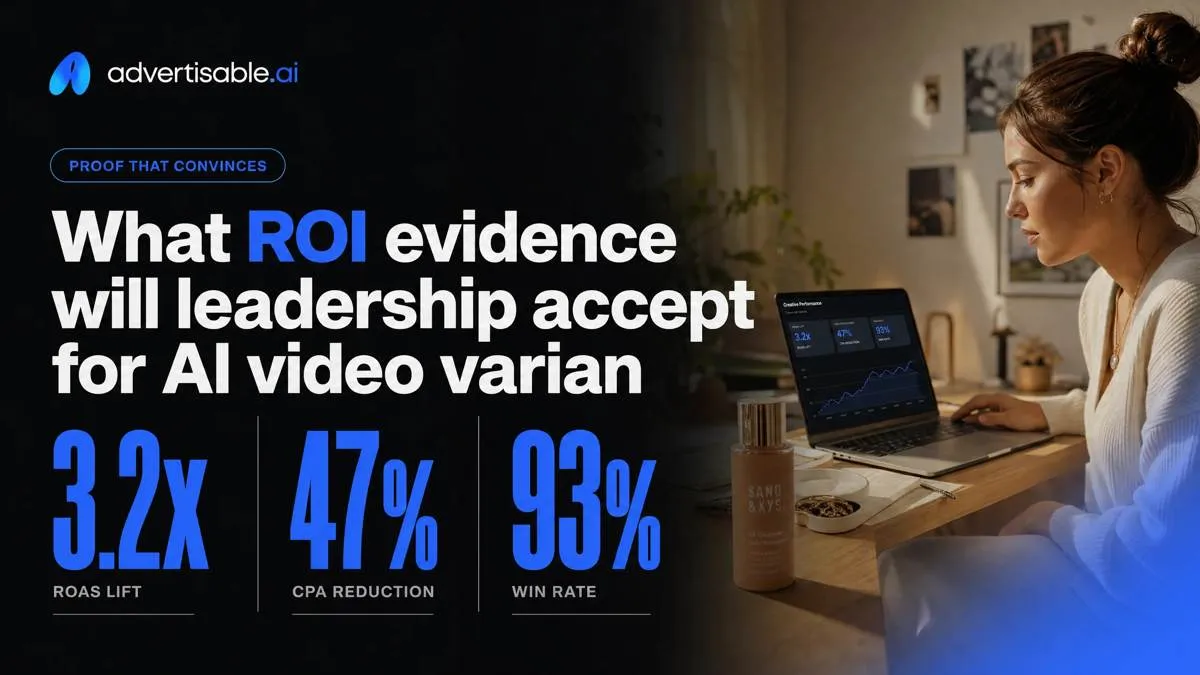
What ROI evidence will leadership accept for AI video variants?
Single-variable batch testing rules
Leadership accepts ROI evidence when you can prove causality: the only thing that changed was the creative variant. Your job is to remove media, audience, and offer noise so Finance can’t dismiss the result as “spend mix” or “promo timing.”
Run storyboard-first batches and enforce QA before launch: verify the URL facts match, claims don’t drift, and the CTA is identical across versions. In our workflows, scene-level edits matter because they let you change one component without accidentally changing everything.
- Hold offer and landing constant: same price/promo, same landing page, same checkout flow
- Lock audience and placements: same targeting, same exclusions, same placement set, same schedule and bid strategy
- One change per batch: regenerate only one scene (hook, proof, CTA, or visual style), then ship the rest unchanged
30-day split test for social
A 30-day test that leadership signs off on uses your best human-made ad as the control and gives AI variants equal delivery conditions. The goal is not “a winner”; it’s a repeatable delta you can forecast.
Track business metrics, not just platform signals: CPA, MER, and CVR. Use 48 to 72 hour readouts to kill clear losers fast, then recycle budget into the top 20% of variants for the remainder of the month.
- Control: your current best human creative, unchanged
- Test cell: AI variants that only change one element per batch
- Cadence: check CPA and CVR every 48 to 72 hours; keep spend distribution stable unless a variant is clearly inefficient
Holdout logic for CTV lift
CTV ROI is credible to leadership when you can show incremental lift with a holdout, not just last-click. Use geo or audience holdouts so the comparison group is truly unexposed.
With incrementality testing methodology, you quantify outcomes like site visits or sales above baseline; for example, an exposed group converting at 2.5% versus 2.0% in control is 0.5 percentage points of lift. Align frequency caps across exposed and control markets so “more impressions” doesn’t masquerade as “better creative.”
- Holdout type: matched geos (heavy CTV vs none) or platform-level audience holdouts
- Outcome: define one primary KPI upfront (site visits or sales) and keep it fixed for the full test window
- Frequency cap alignment: same cap rules and measurement window across cells to avoid biased reach and repetition
What breaks first in AI video workflows and how do you price the fixes?
Cost overruns in AI video production rarely come from generation time. They come from fixes that force human review loops or full rerenders, so you should price work by “minutes of rework avoided,” not by prompts or raw outputs.
Brand DNA drift and scene errors
The first thing to break is brand fidelity, and it is expensive because it creates subjective feedback cycles. Price these fixes by counting how often you can correct a single scene instead of restarting an entire timeline.
Treat drift as three failure classes with separate acceptance checks: logo and color accuracy, product anatomy correctness, and continuity across adjacent scenes. In our workflow, we lock Brand DNA guardrails before generation and only regenerate the offending scene when a check fails, which is why Advertisable AI is built around storyboard-first, scene-level control.
- Logo misuse and color shifts: logo placement, clearspace, and exact brand palette match against your reference pack
- Product anatomy inaccuracies: labels, ports, textures, count of components, and how the product opens, dispenses, or assembles
- Scene continuity failures: wardrobe, lighting direction, hand positions, and prop locations matching between scene N and N+1
Spec failures that trigger rerenders
Spec failures are the fastest way to turn “cheap variations” into rerender debt. Price them as a hard tax: every miss forces exports, uploads, and re-QA across versions.
Set non-negotiable export gates before anyone reviews creative intent. One spec check that catches a bad format early is worth more than ten rounds of subjective notes later.
- Aspect ratio and safe zones: 9:16, 1:1, 16:9 plus UI-safe margins for each placement you actually buy
- Caption burn-in standards: font, size, contrast, max characters per line, and reserved space so captions do not collide with platform overlays
- Audio, loudness, subtitles: target loudness, no clipped peaks, subtitle timing, and a “subtitles on” playback check
Review bottlenecks you can standardize
Review time balloons when feedback is unstructured and untraceable. You reduce it by turning review into pass-fail checkpoints with named owners and a two-pass cadence.
- QA acceptance criteria checklist: brand checks, spec checks, claim and disclosure checks, plus a single “ship or regenerate” decision per scene
- Two-pass review cadence: pass 1 is objective QA (fail fast), pass 2 is creative performance intent (single-variable notes only)
- Asset naming and traceability: version IDs tied to prompt, Brand DNA snapshot, source product URL, and which scenes changed
Which disclosure and synthetic media rules change your cost model in 2026?
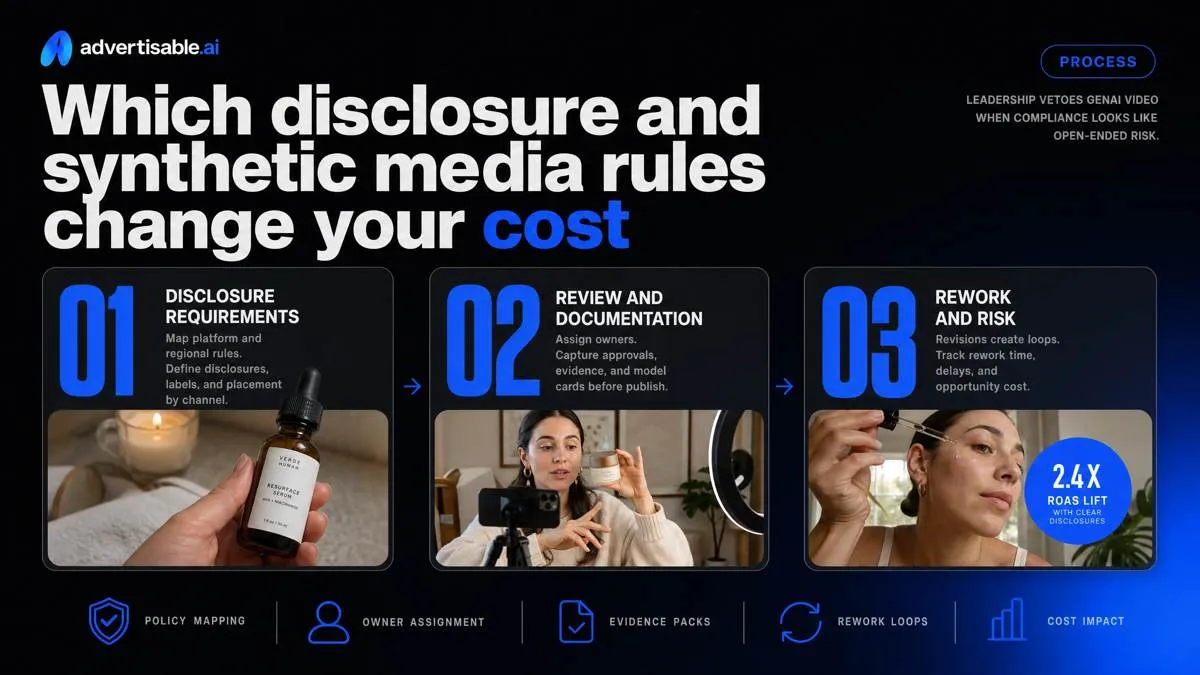
Leadership vetoes GenAI video when compliance looks like open-ended risk. Your cost model changes when disclosure and review become required steps with owners, evidence, and rework loops.
Platform policies you must follow
Platform rules add labor because they force labeling decisions and re-edits before launch. Plan 1 extra review pass per batch for synthetic media labels, sensitive-topic flags, and “misleading edit” checks.
Build a pre-export QA gate that answers three yes/no questions and blocks scheduling until cleared.
- Synthetic media labels: confirm the platform’s “AI-generated/altered” toggle is set correctly for every cutdown and locale variant
- Political and sensitive content: require an explicit flag review for elections, public policy, health, finance, and crisis-related visuals or voiceover
- Misleading edits: ban edits that change meaning (spliced quotes, fabricated “before/after,” altered packaging, or implied endorsements not shown)
State and federal disclosure risks
Your biggest legal cost driver is deepfake and impersonation risk, because the fix is usually a re-shoot or full regeneration. Treat any real-person likeness, voice, or “looks like” casting choice as a legal review trigger.
For substantiation, assume endorsements and testimonials require proof in your files, not in your memory.
- Deepfake and impersonation limits: disallow synthetic use of identifiable individuals (or lookalikes) without documented rights and disclosures where required
- Endorsement and testimonial substantiation: keep the underlying evidence for every claim the script implies, including creator relationships and typicality
- Recordkeeping for claims review: store the final approved script, claim support, and reviewer notes for each concept ID
Your legal-ready audit trail
An audit trail is what turns “we’re compliant” into something counsel can defend in hours, not weeks. Make it automatic: every asset gets a folder, every change gets a log, and every approval has a named owner and timestamp.
In our workflow, storyboard-first and scene-level regeneration only works at scale if your logs follow the scene IDs, not just the final export name.
- Source files and prompt logs: save prompts, negative prompts, inputs, and version history tied to a creative ID
- Model and asset provenance: record which model, voice, avatar, stock asset, and license terms were used per scene
- Approval timestamps and owners: capture who approved (brand, legal, media) and when, plus what changed after approval
A 30-day plan to validate spend before you scale headcount
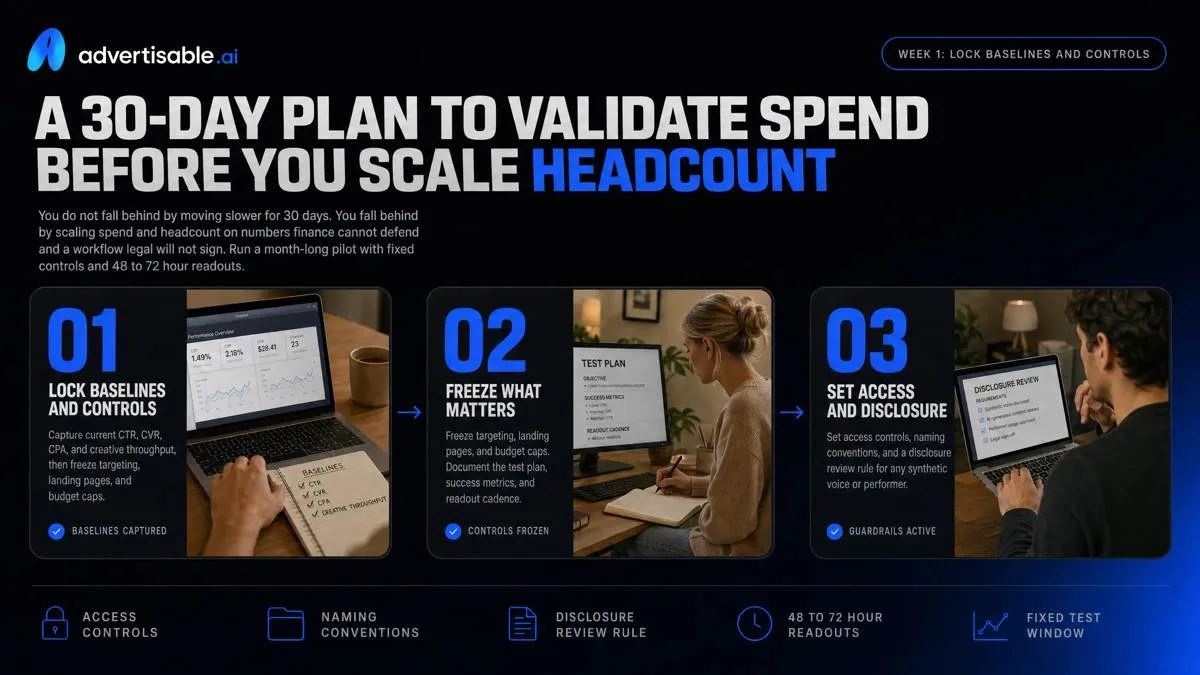
You do not fall behind by moving slower for 30 days. You fall behind by scaling spend and headcount on numbers finance cannot defend and a workflow legal will not sign. Run a month-long pilot with fixed controls and 48 to 72 hour readouts.
Week 1: lock baselines and controls. Capture current CTR, CVR, CPA, and creative throughput, then freeze targeting, landing pages, and budget caps. Set access controls, naming conventions, and a disclosure review rule for any synthetic voice or performer.
Week 2: ship single-variable batches: 10 to 20 variants where only the hook or first scene changes. Add QA gates: Brand DNA accuracy, claim checks, platform specs, and export readiness. In Advertisable AI, we keep this tight by regenerating only the scenes that fail QA.
Week 3: shift a defined slice of spend from the incumbent winners to the best AI variants, hold everything else constant, and run 48 to 72 hour readouts with kill criteria.
Week 4: update TCO with real cycle times (generation, edits, review, re-exports), then decide: scale, iterate another month, or stop. Download our AI video ads 2026 planning checklist to document KPIs, gates, and the scale decision.
Download the checklist and turn AI video into a measurable system
If you want AI video to survive budget review in 2026, you need an operating model your team can audit. Our AI video ads 2026 planning checklist gives you a step-by-step workflow to do three things fast: benchmark your current video KPIs, map a production flow with brand safety and legal review checkpoints, and run a 30-day ROI test where you change one variable at a time and hold the rest constant.
We built Advertisable AI for this exact constraint. You start from a product link, we extract Brand DNA guardrails, then you generate scripts and storyboards you can edit at the scene level so your tests stay controlled and export-ready.
Download the checklist, then use it to decide what to regenerate, what to lock, and what to scale based on your 48 to 72 hour readouts.