What Is an AI Creative Director Role in 2026?
An AI creative director in 2026 is the person who governs how AI is used to produce creative so your team ships faster without drifting off-brand. You set the guardrails, define the workflow, and own the quality bar, which means AI accelerates production but you still control judgment.
Here’s what matters most right now:
- Treat AI as a production multiplier, not a decision-maker for taste or strategy.
- Lock one shared source of truth for product facts and brand presentation.
- Use storyboard-first generation so structure stays stable while variables change.
- Run one-variable batches, then decide next tests from a 48-72 hour readout.
- Fix weak performance with scene-level edits, not full rebuilds that waste credits.
- Track brand accuracy rate, revision loops per ad, and time to first draft.
- Prevent an AI team vs traditional team split that breaks consistency and morale.
We built Advertisable AI for this exact problem: scaling video ad creative without losing control. Our workflow starts from a product URL to extract Brand DNA as guardrails, then moves through storyboard generation, scene regeneration, and frame-by-frame QA so you can ship production-ready exports for Meta, TikTok, and YouTube without turning your brand into a content firehose.
Next, we will get specific about what an AI creative director does day to day, including the exact decisions you own, the QA checks that prevent off-brand drift, and how you keep speed and accuracy aligned.
What does an AI creative director do, exactly?
An AI creative director is accountable for creative judgment while AI accelerates production. Direction starts earlier than before, because the constraints and decisions must be set before anything gets generated.
The job is governance
Your job is to turn brand consistency into a hard constraint, not a nice-to-have. Leadership can treat AI like “strategy,” but AI only scales what you approve, including mistakes.
You own decisions: what claims are allowed, what “proof” is acceptable, what the tone is, and what gets shipped. That is different from being the person who writes prompts.
Practically, you define approved inputs and controlled outputs so the team cannot accidentally publish off-brand creative at volume.
- Approved inputs: locked product facts, offers, required scenes, forbidden claims, voice rules
- Controlled outputs: QA checks for claim accuracy and brand fit before export, plus a clear “reject and regenerate” path
The job is workflow design
Your job is to design a repeatable system: storyboard first, generate second, then iterate with discipline on a 48-72 hour readout.
You map approval gates and handoffs so each draft has an owner and an acceptance bar. Harvard Business Review research links structured workflows to a 30% reduction in time wasted on administrative tasks, which is exactly where AI programs fail when governance is missing.
- Storyboard before generation: hook, product moment, proof element, CTA are defined at the scene level
- Approval gates and handoffs: brand QA, performance review, then export readiness, each with a named approver
- Single-variable variation batches: change one scene element (hook, proof, CTA), hold the rest constant
Why do AI-enabled teams drift off-brand so fast?
AI drift is mostly math: volume amplifies small inaccuracies until they look like “the brand.” More options also increase indecision, so teams ship whichever variation feels plausible instead of what is correct.
Three inputs cause most drift
Off-brand output usually traces back to three unlocked inputs, not a lack of talent. When you scale to 10 to 20 variations per cycle, any ambiguity becomes a production defect.
Drift shows up when product facts and claims are not locked, brand presentation is treated as “vibes,” and each ad is generated without a consistent creative anatomy.
- Unlocked product facts and claims: specs, offers, and proof elements shift between versions, creating unapproved promises
- Inconsistent tone and visuals: fonts, colors, and voice change by prompt, so your brand stops looking like itself
- Missing creative structure per ad: no repeatable hook, product moment, proof, CTA sequence, so every output invents its own logic
Speed without gates creates rework
When you increase generation speed without approval gates, you do not get velocity, you get rework. The failure mode is predictable: output sprawl, late fixes, then rebuilds.
Shadow AI creates multiple “almost final” versions across docs and chats. Legal and brand reviews then happen at the end, when the only option is rewriting scripts or re-cutting the whole video.
That is also where credit economics breaks: instead of fixing one weak scene, you regenerate full ads and burn credits on rebuilds.
- Shadow AI output sprawl: parallel drafts with no single source of truth
- Late-stage legal and brand fixes: claim, pricing, and tone corrections after the creative is already assembled
- Credit waste from full rebuilds: whole-ad regeneration to fix one hook, product moment, or proof beat
Day 0-30: lock product facts and brand presentation
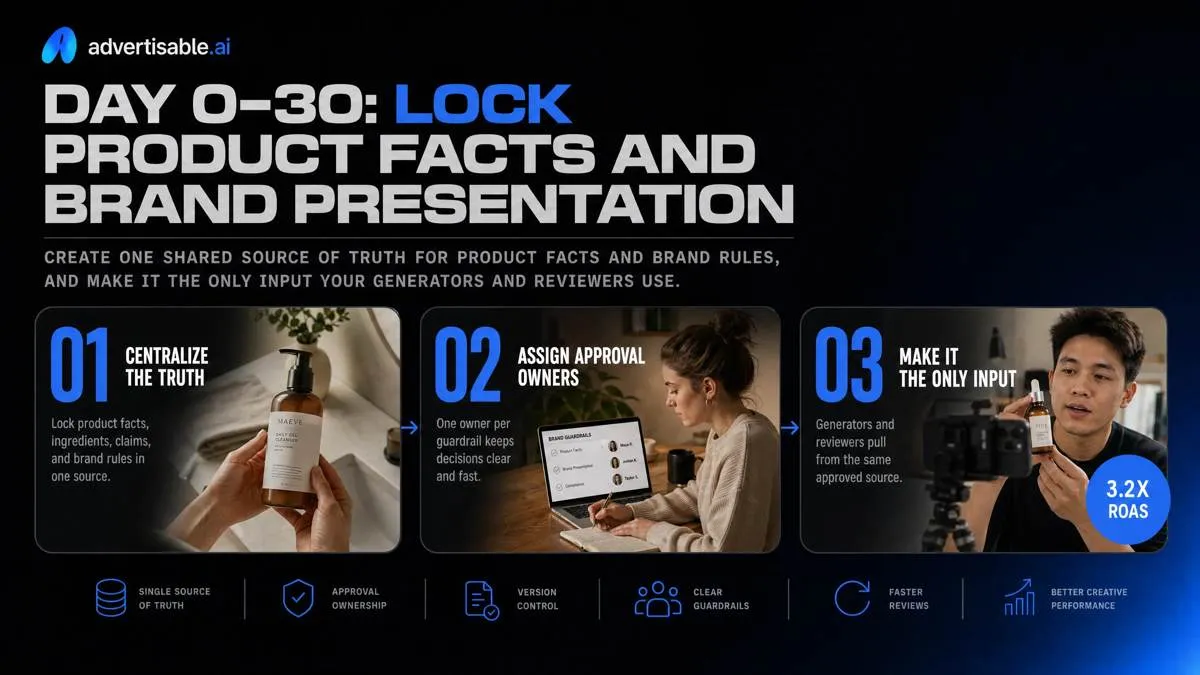
Chaos shows up when “truth” lives in five places. Create one shared source of truth for product facts and brand rules, and make it the only input your generators and reviewers use.
Assign one approval owner per guardrail (product facts, brand presentation, compliance) so decisions do not bounce between teams or get reopened mid-production.
Lock product facts first
Off-brand output usually starts as wrong product truth, not wrong writing. In the first 30 days, you lock what can be said, what must be said, and what can never be implied.
Treat this as a testable spec sheet for creative: the same “facts pack” must survive 10-20 variations without drifting.
- Claims, specs, offer boundaries: approved benefits, measurable specs, price or promo rules, eligibility, shipping and returns lines that cannot change
- Proof sources and citations: where each claim is substantiated (PDP copy, lab results, clinical summaries, internal policy), plus who maintains the evidence
- Disallowed language list: banned absolutes and medical or financial promises; also block fuzzy placeholders like “best,” “cures,” or “works for everyone”
Define brand presentation rules
You cannot review for “on-brand” if nobody can measure it. Convert taste into rules: tone, visuals, and readability that a reviewer can pass or fail in under 2 minutes.
For sound-off performance, assume the first 2 seconds must communicate the hook in text and imagery, not narration.
- Tone and forbidden phrasing: what you sound like, plus words you never use (including overhyped adjectives and sarcasm that breaks trust)
- Visual do and do-not list: logo treatment, color and font constraints, product depiction rules, and prohibited stock styles
- Sound-off readability standards: max words per line, minimum on-screen duration, contrast rules, and mobile-safe text sizing
Set compliance and disclosure gates
Speed comes from predictable gates, not endless rewrites. Set three checkpoints and make them non-skippable before export.
Your baseline: FTC endorsement disclosures when you use testimonials, creators, or implied partnerships; platform ad policies by channel; and claim substantiation reviews before any “proof” line ships.
- FTC endorsement disclosure basics: clear, unavoidable disclosure placement and language when an endorser is compensated or has a material connection
- Platform policies for ads: maintain a channel-specific policy sheet (Meta, TikTok, YouTube) with blocked categories and restricted phrasing
- Claim substantiation checkpoints: evidence attached to each claim, reviewer sign-off, and a reject rule when proof is missing
Day 31-60: run storyboard-first production with approval gates
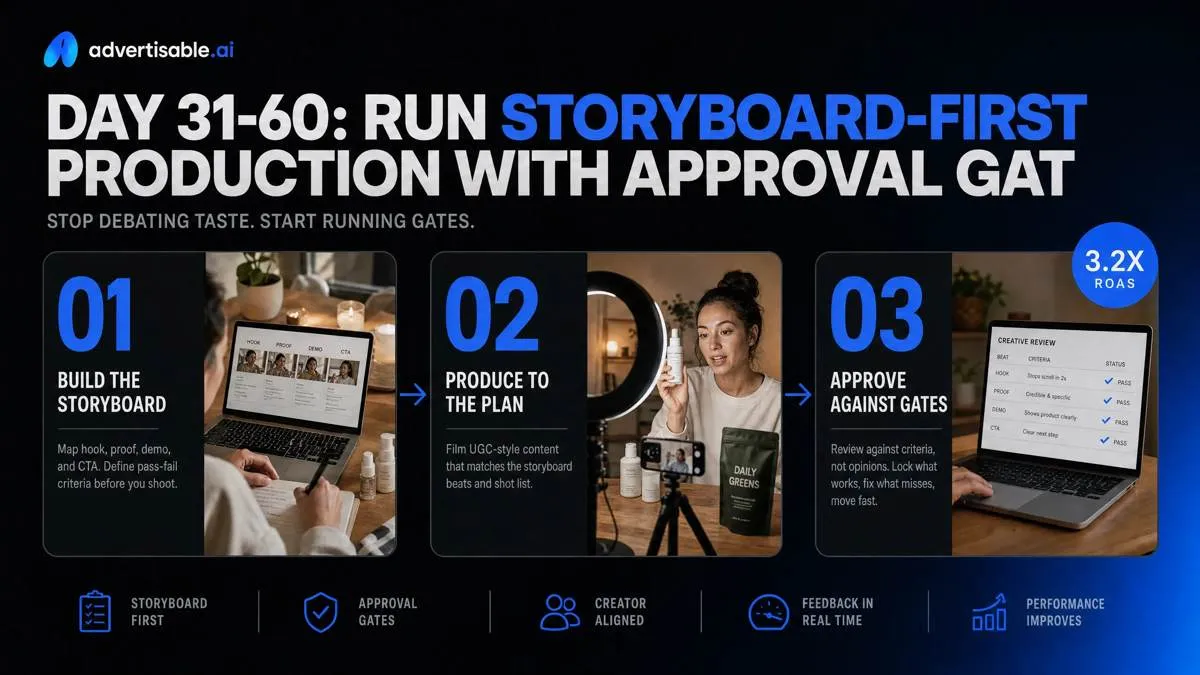
Day 31-60 is where you stop debating taste and start running gates. A storyboard-first workflow forces decisions upstream, so feedback is about pass-fail criteria, not opinions, and you avoid last-minute claim rewrites after assets are already generated.
Use winning ad creative anatomy
Your acceptance criteria starts with anatomy: every concept must earn attention in 2 seconds, show the product early, then land one proof and one CTA. This structure keeps AI output comparable across variations and prevents the “cool but unclear” edits that burn cycles.
Hold the structure constant while you test one variable at a time (usually the hook angle), then read results in 48-72 hours before changing anything else.
- Two-second hook: a single, repeatable promise (outcome, pain point, or audience call-out)
- Early product moment: product shown and tied directly to the hook’s promise
- One proof element: one believable reason to trust (not stacked claims)
- One CTA: one action the viewer can take immediately
Storyboard becomes the contract
Treat the storyboard as the contract you approve before any generation. You write intent per scene so reviewers can approve meaning, claim boundaries, and pacing without reacting to voice, visuals, or editing style.
Lock what stays constant, and explicitly name what is allowed to vary, so iteration is controlled instead of chaotic.
- Scene intent statement: “This scene must communicate X in under Y seconds without implying Z”
- Constants: Brand DNA facts, required product visuals, claim wording, CTA action
- Variables: hook phrasing, proof type, opening pattern, first line cadence
- Approval handoff checklist: pass/fail on claims, product accuracy, hook clarity, single-proof rule, single-CTA rule
Day 61-90: how do you scale testing in 48-72 hour cycles without wasting credits?
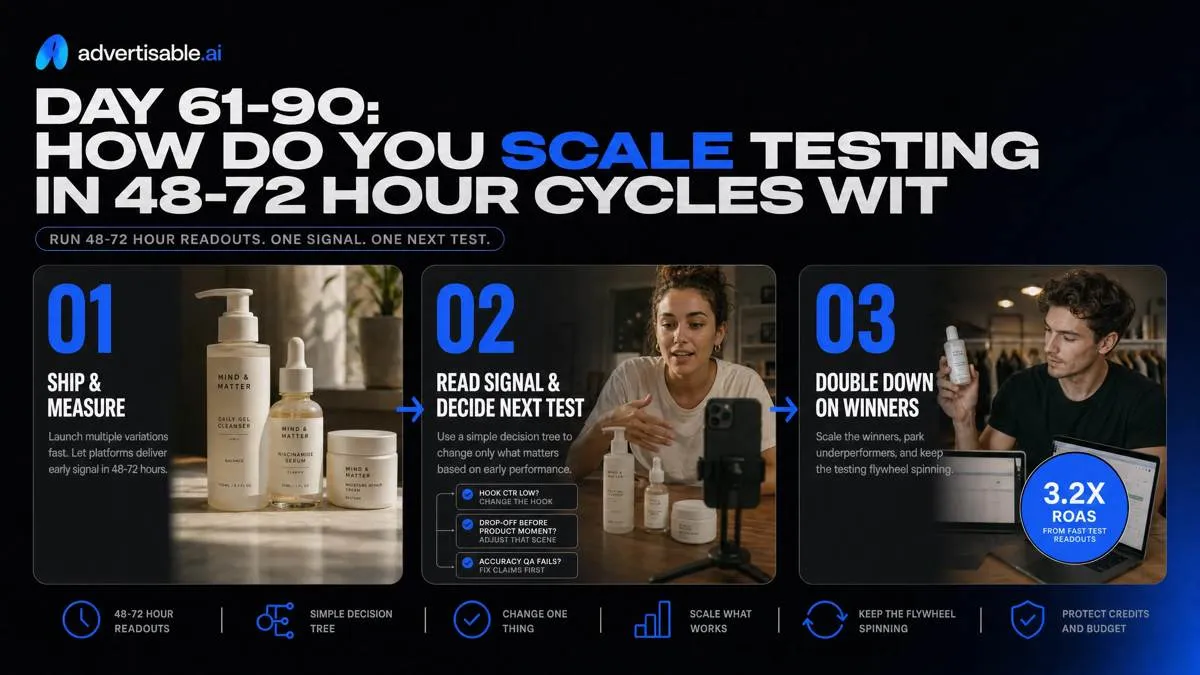
Run a 48-72 hour readout cadence: ship, wait for early signal, then decide the next single test. Use a simple decision tree: if hook underperforms, change only the hook; if hook holds but drop-off hits before the product moment, adjust that scene; if accuracy QA fails, fix claims before you scale spend.
One-variable variation batches
Start by varying hook type first because it drives the largest swing in stop rate and first 3-second retention. Keep the storyboard constant so you can attribute performance to one change, not a new structure.
Batch to match channel behavior: generate 10-20 hook variations per channel, all mapped to the same creative anatomy (hook, product moment, proof, CTA).
- Hook types to rotate: outcome promise, pain-point callout, audience callout
- Hold constant: scene order, product moment timing, proof format, CTA placement
- Batch size: 10-20 per channel, then pick 2-3 winners for the next cycle
Scene-level regeneration rules
Do not rerender the full ad when the first two seconds are weak. Regenerate only the hook scene, then rerun the same storyboard so you keep learning velocity high without burning credits.
Lock product moment accuracy as non-negotiable: the visuals and wording must match the Brand DNA facts you approved. In Advertisable AI, we use the Scene Regenerator to swap just the failing scene and recheck claim and offer accuracy before export.
- Fix weak hooks only: low thumb-stop, low 3-second hold, or comments signaling confusion
- Preserve product moment accuracy: no new claims, no changed specs, no offer drift
- Avoid full-ad rerenders unless multiple scenes fail QA or the structure is wrong
What success looks like
Run a one-week baseline first, then improve from real drift data, not opinions. Tie every KPI to spend protection: fewer off-brand rejections, fewer rebuilds, more shippable variations per test cycle.
The KPI dashboard that matters
Governance is working when you can predict throughput without brand risk. We track three numbers weekly and only change one variable per batch so you can attribute movement.
Targets we use: brand accuracy rate at 98%+ on first pass, revision loops at 1.5 or fewer per ad, and time to first draft under 4 hours from brief to storyboarded cut.
Quality control leading indicators
Lagging KPIs hide the real issue: where the pipeline is failing. You want leading indicators that tell you what to lock (Brand DNA) versus what to regenerate (scenes).
- Percent of variations needing claim fixes: target under 5%; above that, tighten product facts and proof elements before generating more.
- Percent requiring tone rewrites: target under 10%; above that, clarify voice rules and hold structure constant.
- Scene failure rate by type: track hook, product moment, proof, CTA; any type over 15% becomes the only scene you regenerate next cycle.
Failure modes you need to prevent
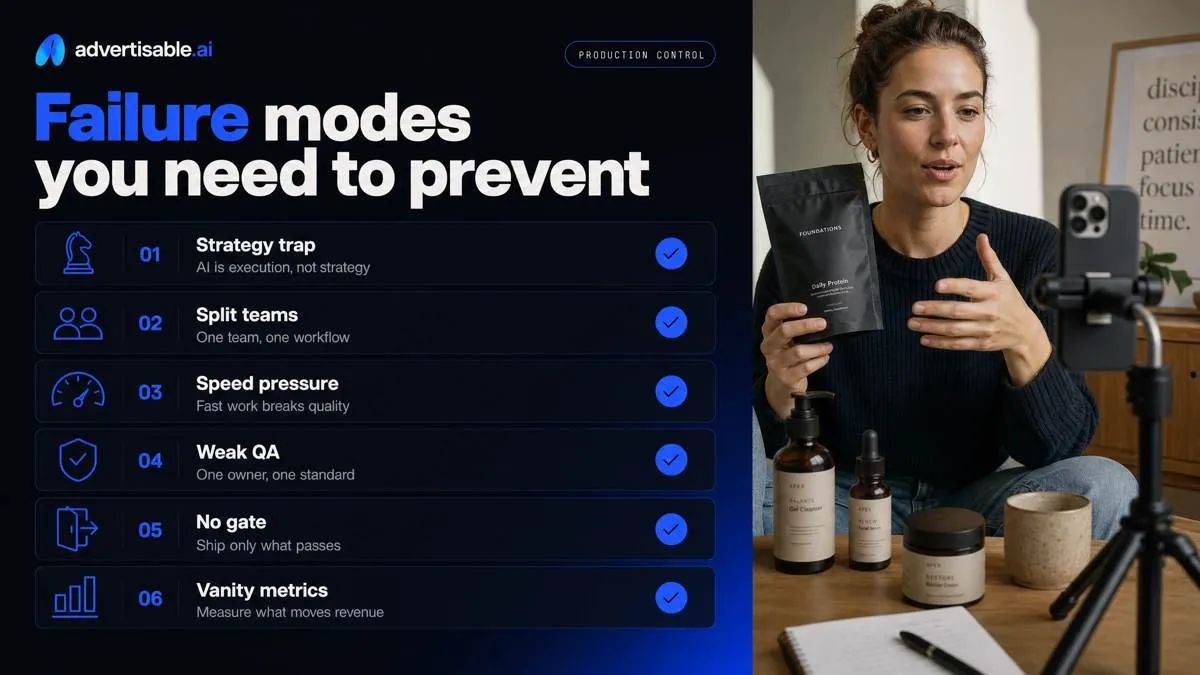
The fastest way to wreck an AI rollout is treating it like strategy replacement instead of production control. Avoid splitting an “AI team” from “traditional creatives”; it creates two quality bars and doubles rework. Build one workflow with one QA owner and one acceptance gate.
Speed pressure is the next morale killer. 2026 Hubstaff workforce research found 46% of AI users report increased work expectations since adopting AI. Your countermeasure is simple: ship in single-variable batches with 48-72 hour readouts, and hold the storyboard structure constant so people are not firefighting ambiguity.
Do not over-index on AI-only skills. You still need brand judgment, claim accuracy checks, and scene-level edit instincts; otherwise you produce volume that cannot pass review. Finally, stop leadership from outrunning readiness gates: no scaling past pilot until Brand DNA guardrails, QA checks, and export readiness are consistently met.
Where Advertisable AI fits in this operating model
AI only creates chaos when you let it invent brand and product truth on every prompt. In Advertisable AI, we start with Brand DNA pulled directly from your product URL, then lock guardrails so every variation stays inside the same approved facts and presentation.
From there, the Storyboard Generator forces structure before pixels: hook, product moment, proof, CTA. Your acceptance criteria are simple: no new claims, accurate offer and pricing, and scenes that match your creative anatomy.
When you need speed without waste, you use the scene-level editor to regenerate only the weak scene (usually the hook or proof) instead of rebuilding the whole video. That is how you keep one-variable batches tight and credits focused.
How to run your first pilot with controlled scope
Run a tight pilot: one SKU, one channel, one goal, measured over 48-72 hours. Pick the SKU with the cleanest product page, choose Meta or TikTok, and define one objective metric (e.g., CTR or cost per add-to-cart) while holding everything else constant.
In Advertisable AI, paste the product URL into the Brand DNA Module and lock non-negotiables (product facts, claims, offer, tone). Generate a storyboard in the Storyboard Editor (hook, product moment, proof, CTA), then produce 10-20 one-variable hook variants.
QA at scene level: flag any weak hook or unclear product moment, regenerate only that scene with the Scene Regenerator, then export channel-ready formats via the Platform Export Engine for a controlled test batch.
Run your first controlled pilot, not a volume experiment
If you want the AI creative director role to hold up under pressure, start with one tight pilot and one objective metric, like brand accuracy rate or revision loops per ad. In Advertisable AI, we recommend a storyboard-first workflow that keeps your structure constant while you test one variable at a time.
Step 1: Paste a product URL and use our Brand DNA Module to extract and lock product facts and brand presentation guardrails. Step 2: Generate a base storyboard, then create a small batch of one-variable hook variations. Step 3: After a 48 to 72 hour readout, use the Scene Regenerator to fix only the weak scenes while holding the rest of the creative anatomy steady.
Step 4: QA with frame-by-frame checks for claims and export readiness, then ship channel-ready assets via the Platform Export Engine.
Frequently Asked Questions
### What does a creative director do exactly?
You set the constraints that make creative shippable: what must be true, what must stay consistent, and what can vary. In an AI workflow, your job shifts from policing outputs to designing the guardrails, approval gates, and QA checks that prevent off-brand drift.
### What's the difference between this platform and high-volume static ad generators?
Advertisable AI is built for video ad creative with Brand DNA guardrails, storyboard-first creation, and scene-level fixes. If you need controlled 48 to 72 hour test cycles and the ability to regenerate only the failing scene, you want a video workflow, not a static volume tool.
### How do I avoid off-brand outputs when scaling to 50+ variations weekly?
You lock three things before you scale: product facts, brand presentation rules, and a repeatable storyboard structure. Then you run single-variable batches and reject any variation that fails claim accuracy or brand consistency QA before export.
### Why does scene-level control reduce wasted credits?
Because you stop rebuilding full ads to solve a local problem. When only the hook or proof scene underperforms or fails QA, you regenerate that scene and hold the rest constant, which keeps tests cleaner and production more predictable.